
A universe of possibilities
Aevoriana Station
A universe of possibilities · WeltraumFeed · News & discoveries
Every day, this feed brings together fresh, easy-to-read news from many fields – from science and space to nature and the environment, art, music and good news. New discoveries are added every morning.

Discovery article
Interpreting AlphaFold correctly: structure predictions need uncertainty information
Predicted protein structures can provide substantial support for biological research. However, their vivid presentation must not obscure the fact that they are models with regions of varying confidence. The AlphaFold database and EMBL-EBI training materials explain how confidence scores help. A structure prediction neither replaces every experimental measurement nor automatically tells us about a protein's function.

Discovery article
AI image descriptions: Useful when the purpose is clear
Automatically generated text describing an image is not necessarily a good accessible alternative. What matters is the information the image conveys in its particular context. AI can provide drafts and draw attention to overlooked details. For charts, complex illustrations and uncertain recognition, however, expert review and a description tailored to the context of use remain particularly important.
Discovery article
Data quality: why provenance and selection matter more than sheer volume
More training data does not automatically mean better AI. What matters is which content is included, what is missing and how it was selected. Dataset documentation makes these decisions visible. Open corpora such as Dolma enable further investigation, but do not replace checks on suitability, rights, sensitive information and biases in the eventual area of use.

Discovery article
Detecting hallucinations: What contradictory answers reveal
If a language model gives different answers to the same question when asked repeatedly, this can be a warning sign. Semantic entropy examines such differences at the level of meaning. The approach helps with certain fabricated answers, but it is not a universal truth detector. In particular, consistently repeated errors remain a central limitation of this form of uncertainty measurement in practical applications.

Discovery article
Writing assistance without losing your voice: using AI for specific subtasks
Not every form of writing assistance has to generate a complete text. AI can organise thoughts, compare alternatives or flag passages that are difficult to understand. A clearly bounded task makes it easier to retain control. Research into creative suggestions and the design of accessible content offers pointers on how assistance can remain useful without unnoticed changes to one's intended message.
Discovery article
Evaluating AI effectively: a small test of your own is often more useful than a ranking
Public benchmarks make it easier to compare models, but do not answer every question arising in your own day-to-day work. A manageable, carefully assembled test set can reveal which errors actually matter. Clear criteria, difficult counterexamples and a willingness to assess refusals to answer, clarification questions and the human effort needed for corrections as part of quality are all important.
Discovery article
A link is not proof: How to check AI source references properly
An answer with footnotes can quickly seem more reliable than one without evidence. Yet even real sources can be misattributed or overinterpreted. Anyone using AI for research should therefore distinguish between three questions: does the source exist, does it contain the information claimed, and does that information actually support the conclusion drawn in the specific context?

Discovery article
Small language models: Not doing everything, but being used appropriately
Smaller language models can be attractive for limited tasks: they require less memory and, under suitable conditions, can be run locally. Their quality does not depend on parameter count alone, however. Training data, language, task format and hardware also help determine whether a compact model really is the better choice in everyday use.
Discovery article
AI as a source of ideas: helpful individually, more similar collectively
AI suggestions can make it easier to start writing. At the same time, an experimental study of short stories found a notable trade-off: individual texts received better ratings, while the stories became more similar to one another. For creative work, this does not mean forgoing assistance. It is, however, worth making a conscious choice about when to use AI and what role it should play.

Discovery article
More context does not automatically mean greater understanding
A large context window allows long inputs, but does not guarantee equal attention to all their contents. Research into the so-called Lost-in-the-Middle effect shows why crucial information can be overlooked among many documents. In practice, therefore, the advertised volume of text matters less than reliability on specific retrieval and comparison tasks within a given workflow.
Discovery article
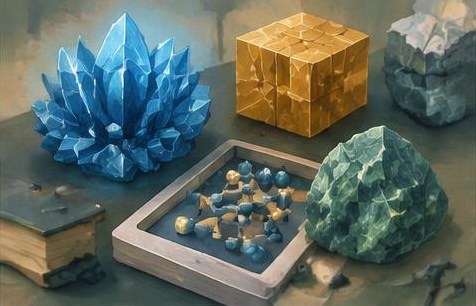
AI in materials research: many candidates do not yet mean finished materials
Machine learning can accelerate the search for new crystal structures and narrow down promising candidates. However, several checks stand between a computationally favourable structure and a usable material. The GNoME research demonstrates the potential of large search spaces. To assess its practical significance, stability, manufacturability and desired material properties must nevertheless be kept clearly distinct.

Discovery article
Reducing the size of multilingual AI without treating all languages equally
A multilingual model does not have to use the same internal capacity for every language. Research into NLLB-200 explores how specialised components can be selectively removed. This can reduce memory requirements. At the same time, it raises an important question about quality: after the adjustment, are the languages and translation directions actually needed still supported well enough?

Discovery article
What multimodal AI recognises in charts — and what it does not
Multimodal models combine text with visual information, enabling them to answer questions about illustrations. A convincing explanation does not, however, mean that all axes, values and relationships have been read correctly. Charts in particular require a distinction between visible observation, expert interpretation and conclusions that cannot be drawn from the graphic alone.

Discovery article
Open AI: why downloadable weights are only the beginning
A model is not fully transparent simply because its weights are available. Training data, code, configurations and intermediate results also matter for research and quality checks. Projects such as OLMo and OpenELM demonstrate different forms of this openness. For users, it remains important to distinguish technical transparency from licensing issues and actual suitability for a task.

Discovery article
AI on your own device: More control, but no automatic privacy
Local AI can process inputs on the device and be useful even without a permanent network connection. This does not, however, mean that every application advertised in this way works entirely offline. Anyone wishing to use sensitive content must examine not only the model, but also logging, additional services, synchronisation and the actual flow of data through the software as a whole.
Discovery article
Quantisation: How language models get by with less memory
Large model files are not immutable. Quantisation stores certain model values at lower numerical precision and can therefore reduce memory requirements and memory transfers. Research such as AWQ shows how important weights can be specifically taken into account. Whether a compressed version is sufficiently accurate and actually faster must nevertheless be tested on the intended hardware.

Discovery article
RAG: Why good AI answers begin with a good search
A language model does not automatically know an organisation’s documents. Retrieval-Augmented Generation therefore combines information retrieval with text generation. This can make answers more traceable, but it does not eliminate errors by itself. What matters is the quality of the passages retrieved, how up to date they are and whether an answer is actually supported by these sources.

Discovery article
When speech recognition first needs to get to know your voice
Speech recognition is not equally accessible to everyone. People whose speech differs from that of those frequently represented in training data experience additional errors and communication barriers. Personalised approaches such as Project Relate investigate how individual speech patterns can be better accommodated. User autonomy, opportunities to make corrections and a realistic assessment of the remaining limitations are crucial.

Discovery article
AI translation: fluent language can conceal important errors
Automatic translation can make communication easier, but linguistic elegance is not a reliable indicator of quality. Particularly with spoken input, recognition, the transfer of meaning and output all need to work together. Research into multimodal translation models shows progress, but also makes clear why language coverage, dialects and subject-specific risks should be assessed separately before a system is used in everyday life.
Discovery article
When AI learns from AI: what model collapse really means
Synthetic training data can be useful, but it is not a risk-free substitute for diverse original data. Research into model collapse examines what can be lost through repeated learning from generated content. The key distinction is this: uncontrolled recursive use of data is different from examples that are deliberately generated, checked and combined with original data.

Discovery article
Bauhaus Is More Than a Look: Learning Through Materials and Experiment
Primary colours and geometric shapes are not enough to explain the Bauhaus. During its existence, the school developed different teaching approaches. Its preliminary course and workshop-based work are particularly revealing. They show design as a learning process that combines perception, knowledge of materials and practical experience, rather than simply passing on a ready-made style.

Discovery article
Biomimicry: Learning from Nature, Not Just Mimicking Its Forms
A leaf-shaped chair is not necessarily an example of biomimicry. The approach asks how biological systems solve problems and translates selected principles into human design. These may involve forms, but also processes and relationships. It remains important to distinguish soberly between inspiring observations of nature, technical applications and genuinely proven environmental effects.

Discovery article
Longevity Is More Than Timelessness: What Makes Good Design Endure
An understated object will not automatically be used for a long time. Design must also function, remain understandable and, wherever possible, allow for continued care. Dieter Rams’ principle of longevity therefore gains its full meaning only in conjunction with other qualities. Historical repaired objects add something crucial to this perspective: an object’s service life is not determined by design alone.

Discovery article
Beyond sight: what multisensory design can achieve
How does design change when touch, sound and smell are not merely additions to the visible? The past exhibition ‘The Senses: Design Beyond Vision’ at Cooper Hewitt brought this question to life. Its examples show why additional ways of perceiving can open up access, and why sensory variety nevertheless needs to be carefully managed.

Discovery article
First the Task, Then the Form: Two Routes to Better Design
What should an object actually do? This simple question connects very different approaches to design. Biomimicry’s functional observation of nature and Dieter Rams’ thinking on usefulness do not begin with a fashionable appearance. Read together, they help us define tasks more precisely and test seemingly elegant solutions for their actual usefulness.
Discovery article
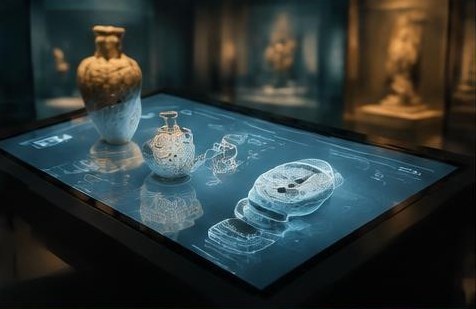
From search result to artwork: reading digital museum collections properly
Digital collections open doors to works that are often not on view in exhibition spaces. Yet a search result is not a complete encounter with an object. The resources offered by the Metropolitan Museum of Art and the Art Institute of Chicago show how images, object data and rights information can be combined into reliable research.

Discovery article
Curated Rather Than Collected: Your Own Themed Journey through Open Museum Collections
Open museum collections invite us to make our own connections between works. Yet a compelling digital selection is more than a series of beautiful images. It needs a question, verifiable object details and a considered approach to rights. Resources from Chicago and the Smithsonian show how these can form a small, responsibly researched themed journey.

Discovery article
Weather in the Museum: Looking Back at Olafur Eliasson’s ‘The Weather Project’
From 16 October 2003 to 21 March 2004, Tate Modern presented Olafur Eliasson’s ‘The Weather Project’ in its Turbine Hall. The installation took an everyday subject and turned it into an exploration of experience and representation. Its historical context helps us understand light art more precisely, beyond striking remembered images.

Discovery article
A House as an Argument: Haus am Horn and the Bauhaus Exhibition of 1923
Haus am Horn was built for the first Bauhaus exhibition in Weimar in the summer of 1923. It gave design ideas a visible spatial and practical form. The documented division of roles and the later publication show how important collaboration and communication were. At the same time, the project is a reminder not to equate experimental architecture too readily with housing proven in everyday use.

Discovery article
Light as a Spatial Experience: James Turrell’s ‘Aten Reign’ of 2013
James Turrell uses light not merely to make something visible. It becomes the very object of perception. His installation ‘Aten Reign’, developed for New York’s Guggenheim in 2013, transformed the rotunda into an altered space of experience. This historical look back shows why architecture, duration and the viewer’s own position are indispensable to such art.

Discovery article
When Movement Becomes Material: Understanding Kinetic Art
A sculpture does not have to stand still. Kinetic art makes movement an essential part of its effect, bringing time, forces and change into the work. There is a wide range of possibilities between motor-driven constructions and mobiles moved by air. What matters is not technical sophistication alone, but the relationship between object, surroundings and viewing.

Discovery article
Contrast is not a clash of styles: making accessible design visible
Accessible design does not begin with a particular aesthetic, but with the question of who can perceive and use information. This becomes particularly clear when it comes to contrast. International web standards provide verifiable benchmarks. They do not replace design decisions, but help distinguish decorative restraint from genuine illegibility and develop reliable visual hierarchies.

Discovery article
The page as a playing field: what the New Typography changed
Asymmetrical pages, striking blocks of type and the combination of image and text have long been part of everyday graphic design. In the 1920s and 1930s, however, these devices were fundamentally re-examined. A past MoMA exhibition shows how the New Typography understood design as the organisation of information, with an influence extending far beyond individual posters.

Discovery article
Still Images, Restless Eyes: The Logic of Op Art
Lines shimmer, planes seem to tilt and rigid patterns create the impression of movement. Op Art reveals that seeing is not a neutral process of recording. Its geometric experiments have a precise place in art history. For contemporary design, they also offer an opportunity to reflect on perception, legibility and the limits of visual intensity.

Discovery article
The Second Form: Repair as Part of Design History
A repaired object tells us about more than damage. It records decisions about what should be preserved and what means were available to do so. Museum collections can make such stories visible. Looking closely reveals, alongside the original design, a second layer of skill, adaptation and appreciation that often receives less attention.
Discovery article
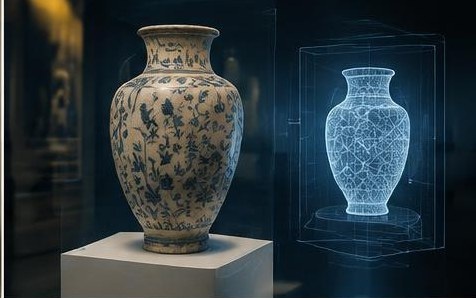
More than Flat Images: What Digital Museum Objects Can Tell Us
A digital collection can contain more than photographs of paintings. Smithsonian Open Access connects different areas of its collections and also points to three-dimensional content. This broadens the possibilities for education and design. At the same time, it remains important to distinguish carefully between the historical object, its digital recording and a new application developed from it.
Discovery article
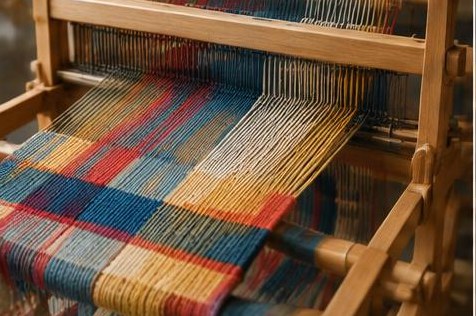
Warp, Weft, Insight: Why Weaving Is a School of Design
A woven fabric is not simply a surface with a pattern applied to it. Its appearance arises from a structure. Anni Albers described these fundamentals with great clarity. Together with material-based teaching at the Bauhaus, her approach opens up a view of design in which structure, manual action and visible effect belong together from the outset.

Discovery article
The book as a whole: William Morris and the designed page
William Morris was interested not only in texts, but also in their visual and material appearance. For him, calligraphy, page decoration and book production formed an interconnected field of work. His engagement with historical models opens up a different perspective on typography from that of later modernism: the focus is not on reduction, but on the interplay of many parts.

Discovery article
Patterns Need Hands: William Morris and Textile Techniques
William Morris is known for plant motifs, but his textile work cannot be reduced to decorative drawings. He explored the processes that make particular effects possible in the first place. Embroidery and other techniques connected design with practical experience. This also reveals why textile design should not be discussed solely through the name of a famous designer.

Discovery article
Labels Are Part of Viewing Art: Accessible Digital Interpretation
An exhibition can offer objects that visitors may touch and still fall short because its information is difficult to read. Accessible interpretation must therefore consider content, presentation and usability together. Experiences from Cooper Hewitt Labs and W3C recommendations show how adaptable text and clear visual decisions can complement a museum visit without creating unnecessary new barriers.

Discovery article
Refurbished is not simply used: quality in refurbishment
Refurbishment promises more than a mere change of ownership. Yet terms such as reconditioned or renewed mean little without explanation. For small suppliers, it is therefore crucial to describe their own process precisely. What inspection takes place, which parts are replaced and what condition is then guaranteed? Clear answers provide guidance in the growing field of used products.

Discovery article
Coworking: Sharing a Space Is Not Yet Collaboration
A shared workplace can bring self-employed people and small businesses into contact with one another. Yet this does not automatically lead to partnerships or better ideas. What matters is having suitable opportunities, clear boundaries and an atmosphere in which questions are welcome. Good coworking practice therefore combines social openness with respect for focused work and differing business interests.

Discovery article
Digitalisation in a small business starts with a well-framed question about the problem
New software often seems like the quickest answer to organisational friction. Yet a digital process does not automatically become clearer or more reliable. Small businesses can therefore begin with a narrower question: which specific task repeatedly causes errors, delays or duplicated work? Only then can they judge what technical support would actually be useful.

Discovery article
Small businesses, good experiments: turning ideas into viable offerings
A new service does not immediately need a major market launch. For small businesses, it may make more sense to test the crucial assumptions first: do people understand the offering, does it fit into everyday life, and can it be delivered reliably? Small experiments help connect creative energy with concrete observations and focus development work more effectively.

Discovery article
Why small online shops earn trust through the details
A small online shop does not have to look like a large marketplace. What matters is whether visitors understand who is behind the offering and how reliably the purchase is likely to proceed. Trust grows from many mutually consistent signals: clear product information, accessible contacts and an ordering process that leaves no unexpected questions unanswered or creates new uncertainty.
Discovery article
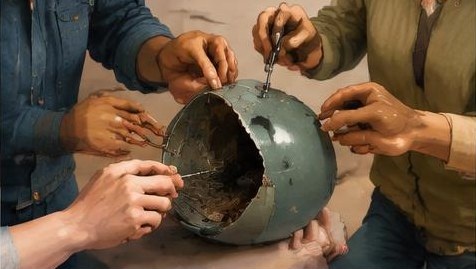
Discussing Mistakes, Improving Quality: A Learning Culture in a Small Team
In small teams, problems often quickly become personal. Roles overlap, decisions are visible and the next collaboration is just around the corner. This makes a reliable framework for open learning all the more important. People who are allowed to voice uncertainty while still knowing the clear quality requirements can bring mistakes to light earlier and work together on better processes without blurring responsibility.

Discovery article
Cooperating as Equals: Small Businesses Need Clear Interfaces
Delivering a service together can open up opportunities for small businesses that would be difficult to access alone. Different skills do not, however, automatically fit into a shared workflow. To prevent cooperation from becoming an additional burden, partners should clarify early on who makes decisions, how information is passed on and which expectations towards customers are genuinely binding and will remain so.

Discovery article
Creative work involves more than the visible hour of labour
A finished logo, illustration or product photograph reveals only part of the work involved. Research, consultation and revision often remain invisible. Clearly describing creative services therefore means making not only the results visible, but also the process. This supports realistic expectations and protects periods of focused work from avoidable disruption in day-to-day project work.

Discovery article
Circular business: why recycling need not be the starting point
A circular business does not wait until a product has reached the end of its useful life to consider its materials. It asks how value can be retained as early as the design and use stages. Repair, resale and refurbishment offer different routes. For small businesses, the priority is to organise a suitable loop reliably rather than embrace as many buzzwords as possible.

Discovery article
One range, two routes: organising the physical and online shop together
Adding an online shop does not simply extend the sales floor; it changes the business. Stock levels, advice, packaging and queries must align across multiple points of contact. For small retailers, the challenge therefore lies less in simply having a digital shop window than in day-to-day operations in which both routes reliably promise and provide the same services.

Discovery article
Sustaining Performance: Why Good Processes Also Allow Time to Recover
A business can get a great deal done in the short term and still be organisationally overstretched. If every deviation is absorbed only by working longer, the causes remain invisible. Sustainable productivity therefore considers not only the result, but also the conditions under which it is achieved. These include reliable processes, reasonable expectations of availability and recovery time that is not constantly punctured by unfinished tasks.

Discovery article
Working More Productively Does Not Mean Responding to Everything Immediately
In a small business, constant availability often seems unavoidable. Customers ask for updates, colleagues need a decision and digital messages arrive at the same time. Yet every immediate response can disrupt the flow of another task. Productivity can therefore also be understood as a question of work design: which interruptions are necessary, which are avoidable and which are better grouped into set times?

Discovery article
Good product copy does not replace advice — it lays the groundwork for it
Online shops offer no opportunity to touch a product, try it on or strike up a spontaneous conversation at the sales counter. Product copy therefore has to do more than create a mood. It helps customers assess size, materials, uses and limitations. Small retailers in particular benefit from descriptions that take recurring customer questions seriously and make products comparable without glossing over their distinctive features.

Discovery article
Repair starts with a good diagnosis – and clear expectations
Repair is often a service carried out under conditions of uncertainty. Before examination, it is not yet clear which part is affected or whether a repair will be possible. Good repair workshops make this process understandable. They explain diagnosis, authorisation and handover separately, providing guidance without promising an outcome that cannot yet be assessed.

Discovery article
Repairability is designed in long before anything breaks
Whether a product can be repaired later is not decided only when it reaches the workshop. Connections, access to components and available information already shape the possibilities at the design stage. Small manufacturers, too, can therefore consider repair early on. This is not just about a technical detail, but about the connection between product quality, service and long-term use.

Discovery article
Leftover material is not a finished concept: working creatively with existing materials
Offcuts, surplus stock and used materials can provide starting points for new products. Using them, however, requires more than an original design idea. Fluctuating quantities, differing properties and unknown histories shape the work. For small creative businesses, the challenge lies in incorporating these characteristics into design and organisation, rather than laboriously compensating for them only during production.

Discovery article
What returns reveal about an online shop
Returns are not merely a logistical process. They can point to unclear product information, unsuitable packaging or expectations that the offering fails to meet. A careful analysis therefore distinguishes between different causes. This is particularly useful for small shops: not every return can be avoided, but recurring misunderstandings need not remain a permanent part of the business.

Discovery article
Second-hand goods in small businesses: trust depends on knowing their condition
Used products are rarely exactly alike. Even identical models differ according to how they have been used, cared for and possibly repaired. Describing the condition of each individual item is therefore central to professional resale. Good information helps people make suitable choices while also showing which checks have been carried out. This can turn an unsorted stream of goods into a clearly documented range.

Discovery article
Transparent pricing: clarity matters more than a wall of figures
Openness about prices does not necessarily mean making every internal cost item public. Above all, customers need clarity about what they will receive, which conditions apply and what additional costs may arise. Good price communication therefore combines a clear overall picture with precisely those details that are genuinely relevant to an informed decision.

Discovery article
Using rather than owning: what a small hire service needs to deliver
Tools, event equipment or specialist everyday items are not always needed permanently. Hiring can therefore be a sensible alternative to individual ownership. Whether it becomes a viable, resource-efficient service, however, depends on more than a booking page. Condition, availability, transport and clear handovers determine how well the model actually works and how readily it is adopted.

Discovery article
Agrivoltaics: two harvests from one area?
Agrivoltaics combines agricultural use with solar electricity generation. This can ease competition for land, but requires more than elevated panels. Shading, machinery access and water distribution must suit the crop concerned. Research and practical experience reveal different designs and potential benefits, but also clear limits to blanket promises of yields across widely differing locations and farms.

Discovery article
The climate-friendly building material may be the component already there
Much of the attention in sustainable construction focuses on new materials. Yet an earlier question is often decisive: what actually needs to be newly manufactured? Retaining suitable existing building fabric and reusing components can avoid demand for materials. This requires careful assessments of existing structures, appropriate planning and a realistic approach to technical and organisational limits.

Discovery article
Bio-based building materials: renewable origins are only the beginning
Timber, plant fibres and other bio-based materials can complement or replace conventional building materials in suitable applications. However, their renewable origins do not guarantee a good overall environmental balance. Raw material sourcing, processing, durability and what happens at the end of use are decisive. It is therefore particularly important to relate material properties and environmental impacts to the specific construction task rather than to a general green label.
Discovery article
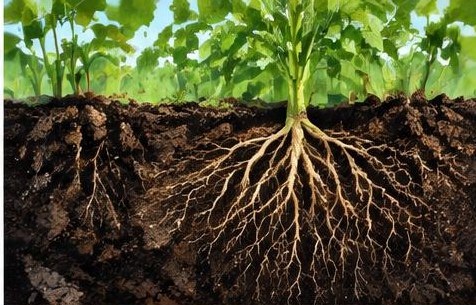
Healthy soils: why carbon alone is not enough as a measure
Soils store water and carbon, support plants and filter substances. Anyone seeking to improve their quality must consider these functions together. More organic matter can help, but does not solve every problem. Compaction, erosion and nutrient imbalances each call for appropriate measures. Progress therefore comes through long-term, site-specific management rather than a single universal recipe for soil.

Discovery article
Buildings that think ahead: shifting electricity use sensibly
An efficient building can do more than use as little energy as possible. It can shift certain uses to different times and thereby respond better to fluctuations in electricity generation. This requires suitable technology, clear comfort limits and understandable controls. Flexibility complements reductions in consumption, but must not encourage either additional waste or unnecessary dependence on complex systems.
Discovery article
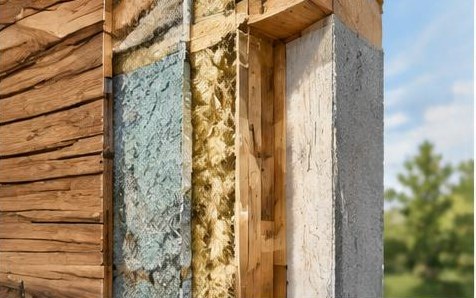
A coordinated approach to insulation: why the building envelope is more than insulating material
Thermal insulation can reduce a building's heating demand and improve comfort. But its effectiveness depends on how it works with windows, thermal bridges, airtightness and ventilation. Looking only at a material's thickness overlooks important relationships. A well-considered renovation therefore gives equal attention to energy consumption, moisture protection and the long-term use of the existing building.
Discovery article
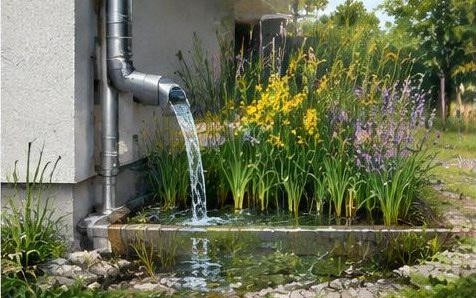
Using greywater: saving drinking water, safeguarding hygiene
Not every use in a building requires drinking-water quality. Treated greywater can, for example, be used to flush toilets and reduce freshwater demand. This requires separate pipes, suitable treatment and reliable operation. Whether a system is worthwhile environmentally and economically depends particularly on the building’s size, its pattern of use and the local water situation in each individual case.

Discovery article
Green roofs as infrastructure: water retention needs planning
A green roof is more than an additional planted area. It can store rain temporarily, delay runoff and contribute to cooling through evaporation. How much it actually achieves depends on its construction and the weather. Retention roofs in particular therefore require careful coordination of structural design, waterproofing, drainage and maintenance secured for the long term.

Discovery article
Light-coloured roofs: when reflective surfaces really help
A roof that reflects a great deal of sunlight can heat up less than a dark surface under the same conditions. This can limit heat entering the building in summer. However, the extent of the benefit inside the building depends on climate, insulation and use. Light-coloured roofs are therefore a location-dependent solution, not a universal cooling trick.
Discovery article
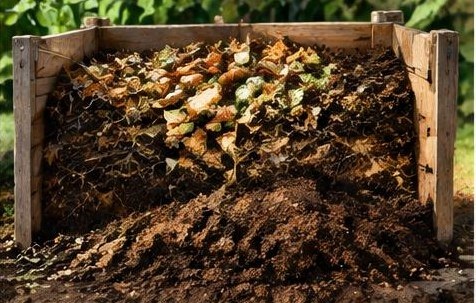
Compost in the circular economy: valuable when quality and quantity are right
Composting can turn organic residues into a usable soil improver. Compost supplies organic matter and nutrients and can improve certain soil properties. But not every soil needs the same amount, and contamination remains a problem. Its environmental benefits therefore begin with clean collection and extend to application according to need at a suitable site.

Discovery article
Rewetting peat soils: climate protection starts with the water level
Drained peat soils lose their stored carbon because peat decomposes when exposed to oxygen. Rewetting can significantly limit these losses. However, it changes the conditions for agriculture and infrastructure. Paludiculture offers opportunities for farming under wet conditions, but requires suitable water levels, adapted machinery and routes to market. Restoration is therefore a long-term water and land management project.

Discovery article
Designing with the sun — and keeping its heat out in time
Passive solar architecture uses building form, windows and thermal mass to incorporate solar energy without elaborate technology. But a house must work in more than just winter. Large areas of glazing can become a burden in summer. Good design therefore combines solar gains with shading, daylight and a robust strategy against overheating in rooms used in different ways.
Discovery article
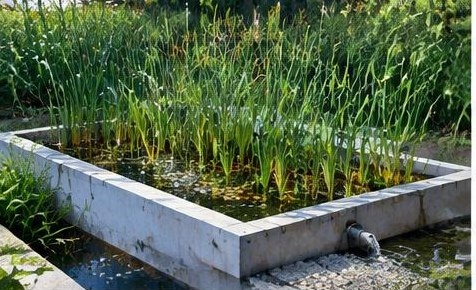
Nature-based water treatment: what planted systems can achieve
Planted treatment systems combine engineering design with biological and physical processes. They can form part of water reuse or decentralised wastewater treatment. Their performance, however, does not come from plants alone. Microorganisms, filter media, water flow and loading are also crucial. Nature-based therefore means neither maintenance-free nor automatically suitable for every site and every water quality.

Discovery article
Sponge cities: rainwater needs space and clean pathways
Cities have to cope with heavy rainfall as well as longer dry spells. The sponge city approach seeks to retain, use or infiltrate water where it falls. This requires connected spaces and suitable soils. Water quality is also crucial: not all runoff can be allowed to enter the ground untreated.

Discovery article
Repairable smartphones: more than a replaceable battery
Using a smartphone for longer can reduce demand for new devices and their materials. For this to happen, a repair must be technically possible, affordable and worthwhile in everyday life. A study by the European Joint Research Centre (JRC) shows that repairability has several dimensions: design, spare parts and service are just as much a part of it as clear information for carrying out repairs.

Discovery article
Recycling solar panels: why glass alone is not enough
End-of-life solar panels contain glass, aluminium, copper, silicon and other valuable materials. Recycling them is therefore more than a waste-disposal issue. What matters is the purity of recovered materials and their reuse. Research demonstrates technical possibilities, but substantial practical and organisational tasks still stand between a successful process and a widespread, economically viable material cycle.

Discovery article
Circular textiles: collected does not mean recycled
Separate collection can prevent used textiles from going straight into residual waste. But it does not in itself create a closed material loop. Sorting, fibre composition and available recovery options determine what happens next. Alongside recycling, the European Environment Agency therefore emphasises quality, longer use, repair and reuse above all as interconnected tasks for the entire textiles system.
Discovery article
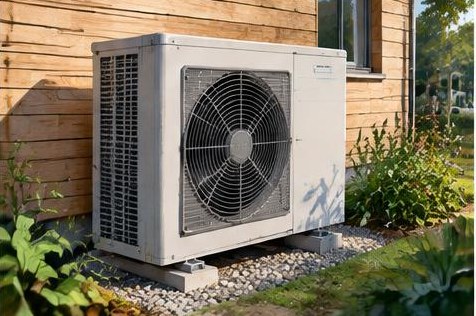
Heat pumps in existing buildings: the whole heating system matters
A heat pump can make ambient heat usable in buildings and significantly reduce the need for purchased energy. How well this works, however, is not determined by the unit alone. Heat emitters, flow temperatures, the condition of the building and controls all interact. A closer look at these relationships helps to develop realistic expectations and avoid unnecessary alterations.
Discovery article
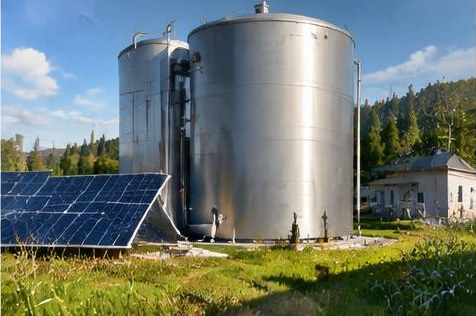
Storing heat: the underestimated complement to wind and solar
Energy does not always have to be stored in a battery. Where heating or cooling will be needed later, thermal storage can be a suitable solution. Its possibilities range from hot-water tanks to specialised industrial applications. Temperature, storage duration and actual demand are decisive – not simply the largest possible capacity on a datasheet.
Discovery article
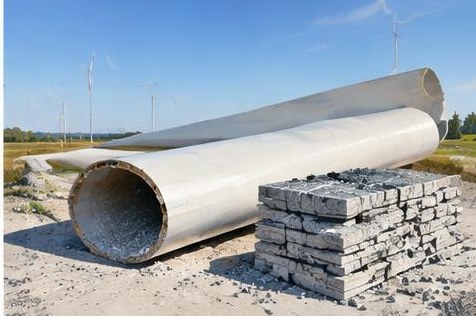
Circular rotor blades: the difficult side of wind technology
Steel and other metals in a wind turbine can, in principle, be readily recovered. Rotor blades pose more difficult challenges for the recycling industry: their fibre composites are designed for strength and durability. New resins open up additional possibilities. Whether these lead to robust industrial material cycles, however, depends on material quality, energy requirements, logistics and commercial demand for the recovered materials.

Discovery article
One less pollutant in the tank: The worldwide end of leaded petrol for cars
An everyday source of lead exposure has disappeared worldwide: leaded petrol for cars has no longer been sold since July 2021. This success came through technical changes and a long-standing international partnership. It removes neither existing contamination nor every source of lead, but shows how an avoidable environmental burden can be systematically brought to an end.
Discovery article
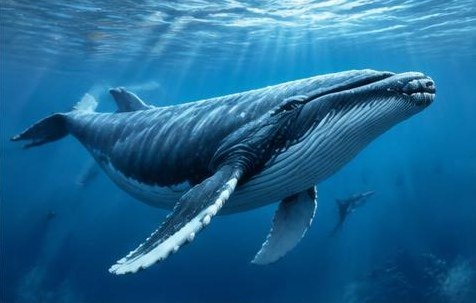
Humpback whales: a historic conservation success that needs a regional perspective
Several humpback whale populations have recovered significantly since intensive hunting ended. In 2016, the US ocean agency NOAA was able to remove nine of fourteen distinct populations from its special threatened-species list. This was a significant milestone, but not a global all-clear: other populations remained threatened, and new pressures still need to be monitored.

Discovery article
More electric cars, less demand for oil: A measurable shift with limits
Electric cars have long been more than a small niche market. For 2024, the International Energy Agency documents more than 17 million sales and a growing vehicle fleet. Particularly telling is the oil consumption already displaced. At the same time, raw material requirements, the source of electricity and the still-large number of conventional cars remain important parts of an honest environmental assessment.

Discovery article
585 gigawatts more: Renewable electricity generation is growing on a new scale
The expansion of renewable electricity generation reached a documented record in 2024. Worldwide, 585 gigawatts of capacity were added, reports the International Renewable Energy Agency. The figures show technological and economic momentum. They do not, however, mean that an equivalent amount of electricity was generated or that all regions of the world benefit equally from the expansion.

Discovery article
Having an account of one's own is becoming more common – and opening up new possibilities
Between 2011 and 2021, the proportion of adults worldwide with a financial account rose from 51 to 76 per cent. The World Bank also documents a smaller gender gap in developing countries. Accounts and mobile money services can make everyday life and economic independence easier. Their mere existence, however, proves neither financial security nor fair terms.

Discovery article
Small foxes, major recovery: what was achieved on California’s islands
Several subspecies of the Californian island fox recovered from dramatic declines within a comparatively short time. Conservation programmes combined population rebuilding with the reduction of specific threats. The case shows how effective targeted ecological repair can be. Small island populations remain vulnerable, however, and need reliable monitoring even after recovery.

Discovery article
227 million additional internet users: more access, but not yet equal participation
The International Telecommunication Union estimated that there were 5.5 billion internet users worldwide in 2024. Compared with the revised figure for the previous year, this was an increase of 227 million people. Digital information and learning resources are therefore reaching more people. However, the differences between poor and rich countries remain large, and an occasional connection is not yet reliable, affordable access.

Discovery article
Fewer child marriages: a slow but measurable gain in life opportunities
The proportion of young women worldwide who were married as children has fallen. UNICEF documented a decline from almost a quarter to about a fifth within a decade. The progress is real, but unevenly distributed. The most disadvantaged girls are often left behind, and the pace is nowhere near sufficient.

Discovery article
More girls are learning for longer: progress beyond enrolment
In 2023, UNESCO documented around 50 million more girls enrolled in school than in 2015. Even more telling is that completion rates also rose. Educational opportunities are thus improving measurably. However, global progress masks substantial differences between regions and social groups, and a school place does not yet guarantee good teaching or successful completion.

Discovery article
Does conservation work? A large-scale assessment offers an encouraging answer
Individual success stories are welcome, but they do not yet answer a fundamental question. A meta-analysis published in 2024 systematically compared conservation measures with situations without corresponding interventions. In two-thirds of the cases examined, biodiversity improved or its decline slowed. This is no guarantee of success, but it is strong evidence that action can be effective.

Discovery article
Nepal’s tiger population is growing — and so is the task of being good neighbours
In 2022, Nepal recorded almost three times as many wild tigers as in 2009. Protected habitats, connected landscapes and collaboration with communities underpin this success. The development is encouraging, but calls for a second measure of success: people living alongside tigers must also be safe and able to benefit from conservation.

Discovery article
Open science gains a shared foundation
Research should not only be produced, but also be accessible, verifiable and usable. An internationally agreed framework and a global stocktake have given open science a stronger shared foundation. For now, the progress lies in collaboration and systematic monitoring. Whether it leads to more equitable research still depends on practical implementation.

Discovery article
The ozone layer is recovering: What decades of cooperation can achieve
Can an environmental system damaged on a global scale recover? The ozone layer provides robust evidence that it can. Almost all controlled ozone-depleting substances have been phased out of use. Measurements and modelling show progress, although full recovery will still take decades and individual years can deviate markedly from the long-term trend.

Discovery article
The Iberian lynx is reclaiming its habitat and its future
From the brink of extinction to a much larger population: the Iberian lynx is one of conservation’s well-documented successes. Breeding, reintroduction and habitat work went hand in hand. Its improved Red List classification is deserved, but does not mean that this rare cat species is already safe without further support.

Discovery article
Collectively funded access: how SCOAP3 opens up specialist knowledge
More than 3,000 institutions support a partnership that makes particle physics research accessible without fees for readers or authors. To mark its tenth anniversary, SCOAP3 documented tens of thousands of published articles. The model demonstrates a practical route to the collective provision of knowledge, but remains dependent on a particular research field and reliable funding.

Discovery article
Millions of seeds brought seagrass meadows back
On Virginia’s coast, a long-term project shows that lost underwater landscapes can return. Researchers documented 3,612 hectares of restored seagrass and the return of important ecological functions. Suitable site conditions and perseverance were crucial. The success therefore offers valuable guidance, but is not evidence that sowing seeds automatically works everywhere.

Discovery article
More people with electricity: Access is growing faster than the population
Electricity enables lighting, communication and many everyday work processes. For 2023, the international energy progress report documents a further increase: around 92 per cent of the world's population had basic access to electricity. The number of people without a supply fell. But a connection alone guarantees neither affordable electricity nor a reliable round-the-clock supply.

Discovery article
More households safely supplied: why drinking water quality matters
International monitoring documents long-term progress in access to drinking water and sanitation. Particularly important is the stricter focus on safe provision rather than provision that merely exists. The data also show how large the remaining gaps are. For women and girls, a reliable connection can also considerably ease the burden of everyday life.

Discovery article
Forest loss has slowed — why this progress needs to be read correctly
The long-term global rate of forest loss has fallen. This is documented by the Food and Agriculture Organization’s global forest assessment for the period up to 2020. The trend shows that losses can be influenced. However, it means neither an end to deforestation nor a full recovery of natural forests, their biodiversity and their ecological functions.

Discovery article
Bald eagles: a recovery that can be counted and checked
The bald eagle represents a remarkable resurgence of a species once under severe pressure. An American population assessment estimated around 316,700 birds in the contiguous United States. Behind such figures lie surveys and statistical models. Putting them carefully into context makes the success more credible than any account of nature having been completely saved.

Discovery article
When fabric listens: a microphone made from woven fibres
Textiles can not only dampen sound but also detect it. A research team at MIT developed fabric containing a special piezoelectric fibre that converts mechanical vibrations into electrical signals. This does not produce an invisible mass-produced microphone for every garment, but it does offer a remarkable approach to incorporating sensors into familiar textile manufacturing processes and distributing them across the fabric.

Discovery article
DextrES: a lightweight glove brakes your grasp in the virtual world
Anyone reaching for a cup in a virtual scene normally feels no resistance. DextrES addresses this gap: flexible metal strips are electrostatically braked against one another, limiting finger movement. The joint research approach from EPFL and ETH Zurich demonstrates tangible grasping with little mass, but remains far from a complete simulation of real hands.

Discovery article
EM-Sense recognises devices by their incidental electrical noise
Many electrical devices unintentionally emit electromagnetic interference during operation. EM-Sense investigates whether these signals can be detected through the body when a device is touched. A watch-format research prototype distinguished between various objects without additional tags on the devices. This is a specialised sensing technique, not a general ability to identify every object touched reliably.

Discovery article
Fairphone 5: The smartphone conceived as a repairable assembly
A smartphone already consists of many parts. What matters is whether those parts remain accessible and replaceable later on. With the Fairphone 5, repair instructions and separately available components are part of the product concept. Its technical distinction lies less in any single new material than in a device architecture that takes typical repairs into account from the design stage.

Discovery article
FoamWork: printed foam gives concrete its internal structure
Complex concrete components need not only a good design but also a mould that can be manufactured. The ETH project FoamWork investigates robotically printed mineral foam as formwork. The invention therefore addresses the stage before the actual casting. A documented slab prototype demonstrates the principle without yet providing a universally approved construction method for arbitrary buildings.

Discovery article
Ports you can swap: the modular edge of the Framework laptop
On many laptops, the choice of ports is fixed for their entire lifespan. Framework, by contrast, treats some of this equipment as interchangeable modules. Small Expansion Cards fit into purpose-built bays and can be combined as needed. Unlike many research projects, this is a marketed product concept with documented installation and removal procedures.

Discovery article
Holding on without glue: grippers based on the gecko principle
Large, smooth surfaces are often difficult to grasp with fingers. Stanford researchers are therefore investigating adhesive structures modelled on gecko toes. Microscopic surface features and a specific loading direction create a controllable grip. This is not a universal adhesive film, but a family of carefully designed research mechanisms whose performance depends heavily on contact, surface properties and an even distribution of forces.

Discovery article
Haptigami: a small folding mechanism makes digital forces tangible
A vibration can signal a notification, but can hardly convey the direction of a touch. Haptigami therefore investigates a compact fingertip interface that also generates pressure and lateral forces. The EPFL development uses compliant transmission mechanisms within an origami structure. It is a research prototype with measured performance for differentiated feedback, not a ready-to-buy glove for arbitrary virtual worlds.

Discovery article
From a soft mesh to a rigid shape: An engineered chain fabric
Chain mail is flexible even though its individual links are hard. Researchers at Caltech and JPL used this contrast to create a structured material with variable bending stiffness. Under pressure, the elements interlock more strongly. The published development demonstrates on samples how geometry can switch mechanical properties; proposed applications remain separate development tasks.

Discovery article
Monarch: A tactile display gives digital graphics a surface that can be felt
A single braille line can make text accessible, but can represent spatial relationships only to a limited extent. Monarch combines multiple lines with an area for tactile graphics. Developed by HumanWare with partner organisations, the device is offered as a product. It shows how digital accessibility can extend beyond speech output without removing the need to prepare diagrams and learning materials carefully.
Discovery article
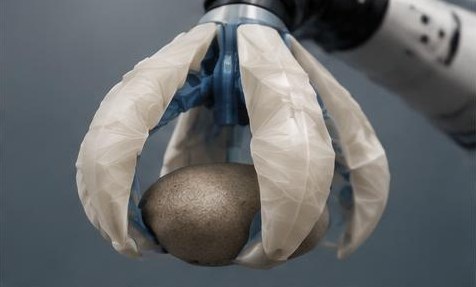
A folded shell instead of five fingers: the origami gripper
A robot does not have to replicate a human hand to pick up very different things. Researchers at MIT and Harvard developed a gripper whose folded shell encloses objects. The research device shows how geometry and soft materials can work together. Its impressive lifting trials, however, are not yet evidence of a universally applicable packing robot.
Discovery article
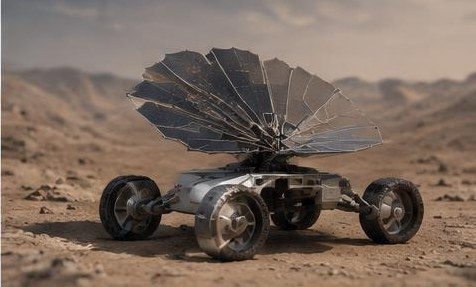
PUFFER: a small rover flattens itself
A large rover can carry valuable instruments, but cannot fit beneath every rock overhang. PUFFER, developed at the Jet Propulsion Laboratory, therefore explores a different division of labour: small folding robots as forward scouts. The devices were tested on Earth. Their association with lunar or Mars missions remains an application concept in the sources described.

Discovery article
This film leaps: A soft material stores energy for movement
When heated, a thin piece of polymer can do more than deform slowly: it can suddenly leap. Researchers at the University of Colorado Boulder and Caltech demonstrated this using specially structured liquid crystal elastomers. The movement exploits a mechanical instability. The result is a materials experiment with potential implications for soft actuators, not yet an autonomously hopping miniature robot.

Discovery article
A starshade made from folds: origami for precision optics
A large shade could block a star’s light so that a telescope can detect fainter companions. But such a structure must first be stowed compactly. NASA researchers tested an origami-inspired optical shield for this purpose. The documented ten-metre test article is a ground-based technology demonstrator and must not be confused with a starshade already flying in space.

Discovery article
A camera counts particles of light with 400,000 pixels
More pixels are of interest not only in ordinary cameras. A team at NIST developed a superconducting camera with 400,000 pixels that can detect individual photons. Its readout architecture is also part of the innovation. The research device requires extremely low temperatures, placing it in a different class of equipment from commercially available photographic or surveillance cameras.
Discovery article
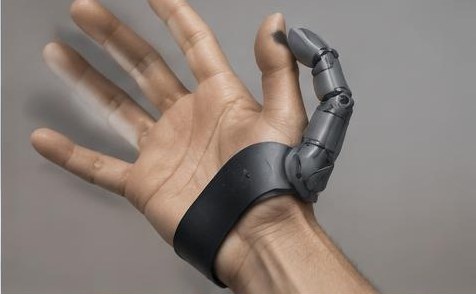
Third Thumb: what an extra thumb changes for the hand
The Third Thumb does not replace a missing finger; it augments an existing hand. Developed by Dani Clode, the robotic extension sits opposite the natural thumb and is controlled through pressure sensors on the feet. Cambridge researchers investigated how different people cope with it. The project is an experiment in motor augmentation, not a promise of effortless extra dexterity.

Discovery article
Touché: one electrode distinguishes more than touch and no touch
An ordinary touch switch often answers only a yes-or-no question. Touché, by contrast, investigates how different hand positions and forms of contact can be distinguished electrically. The research project scans capacitive properties across several frequencies. This allows everyday objects and liquids to become experimental input surfaces, without yet amounting to a robust universal solution for every surface.

Discovery article
UltraButton: a button in mid-air gives a response you can feel
Touchless operation often leaves it unclear whether an input has actually been registered. UltraButton therefore combines distance sensing with light, sound and focused ultrasound. The latter produces feedback on the hand even though it is not touching a solid button. The published development is a tested prototype, not a finished control product available at the stated experimental cost.

Discovery article
3D printing without stacked layers: Light forms an object within a volume of resin
Many 3D printers build an object layer by layer. Computed Axial Lithography takes a different approach: changing light projections strike a rotating container of photosensitive material. Their effects accumulate spatially to produce the desired shape. The research published in 2019 demonstrates an alternative manufacturing principle, not a universal replacement for all layer-based processes.

Discovery article
A porous framework collects water from dry air
Harvesting water from air does not always require an actively cooled surface. A research team investigated a collector containing a metal–organic framework material that binds water vapour and releases it again with the help of solar heat. Trials in Berkeley and Death Valley demonstrate the principle under real-world conditions. However, the documented quantities require careful interpretation.

Discovery article
Listen more closely, claim less: a culture of attention
Mindful music listening requires neither special equipment nor promises about health or cognitive performance. It begins with a focused question and a willingness to review a first impression. Findings about culturally shaped rhythmic expectations and information about concert acoustics help us understand perception as an interplay between experience, situation and the music presented.

Discovery article
When Lines Sound: Daphne Oram’s Different Vision of Composition
Music can be shaped not only by playing or notating it, but also through graphical control. Daphne Oram’s Oramics Machine represents a distinctive approach to electronic sound generation. Its history raises questions about musical interfaces, the visibility of technical work and how museums can explain experimental instruments without turning them into mere curiosities.

Discovery article
Searching with patience: making sense of digital music collections
A search box promises simplicity, but historical music holdings rarely follow a single system of organisation. Names, formats and descriptions come from different periods and institutions. Those who approach digital collections as catalogued sources rather than a comprehensive music search engine find more reliable routes: through precise questions, careful attention to item details and a conscious approach to what is not displayed.
Discovery article
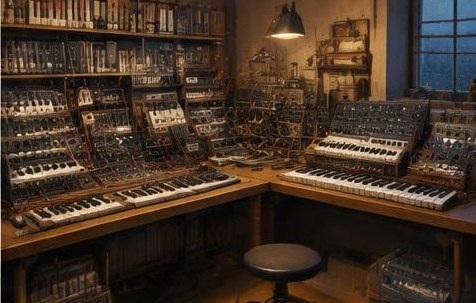
More Than One Inventor: Electronic Music as a History of Workshops
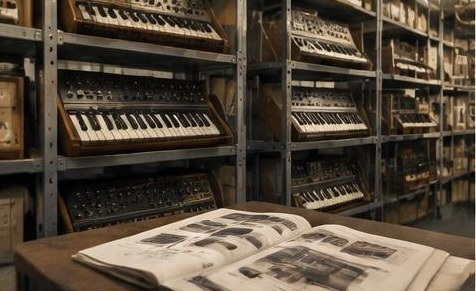
The history of electronic music cannot be reduced to one famous instrument or a handful of names. Museum projects in Munich and Britain present studios as places of collective experimentation. Looking at their equipment, working processes and participants together reveals a multifaceted culture spanning hands-on improvisation, technical research and new ideas about shaping music.
Discovery article
Memory needs disagreement: who documents the history of electronic music
Devices do not preserve the same things as people, and databases retain different information from exhibitions. For the history of electronic music, this coexistence is particularly valuable. Collaboratively developed museum projects and open music data show how knowledge can emerge: through traceable contributions, different perspectives and a willingness to leave gaps visible rather than close them prematurely.

Discovery article
More than a sonic postcard: listening to field recordings in context
A recording can make music accessible across great distances while obscuring crucial context. Anyone listening to field recordings should therefore ask about more than their distinctive sound. Details of the participants, occasion and publication help turn a seemingly unfamiliar discovery into a specific musical encounter, without reducing people to their origins or traditions.

Discovery article
Gamelan: when playing together becomes knowledge in itself
Gamelan refers both to musical ensembles and to their instruments. Anyone listening only for individual shimmering timbres misses an essential element: organised interplay. UNESCO describes rules, interlocking parts and a variety of performance contexts. A context-rich approach to listening makes this not an exotic sonic backdrop, but an encounter with the nuanced musical and craft practices of living communities.
Discovery article
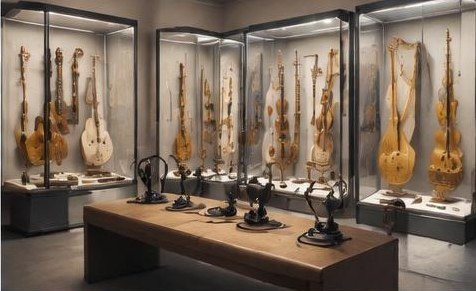
More than looking: how an instrument museum becomes a listening laboratory
Historical instruments tell us about materials, postures and musical ideas. Yet many of their characteristics remain invisible in a display case. An attentive museum visit therefore combines looking at objects with questions about playing techniques and what has been passed down. Digital collections can extend this experience, provided they are not mistaken for a complete substitute for sound, space and a physical encounter.

Discovery article
Voices at a distance: what historical sound cylinders really pass down
Early sound recordings seem to offer a direct encounter with the past. In reality, we always listen through a technical process and a subsequent history of transmission. Sound cylinders make this mediation particularly clear. Their delicate materials, the acoustic recording technique and today's access copies are as much part of the history as the recorded voices and musical performances.

Discovery article
The space plays its part: how concert halls organise listening
A concert hall influences more than reverberation. It shapes proximity, sightlines and attention, while also having to hold disruptive influences at bay. The Elbphilharmonie explains these tasks through its different halls. Together with the site-specific tradition of organ building, this creates a more precise picture of why musical sound can never be considered entirely independently of its location.

Discovery article
Living rather than frozen: what makes musical cultural heritage
A cultural heritage listing can attract attention, but it replaces neither teaching nor shared practice. Musical transmission consists of skills, relationships and ongoing decisions. UNESCO documentation and community-maintained music data demonstrate in different ways why preservation should not be confused with a definitive list. What remains crucial is whether knowledge can be passed on, examined and placed in new contexts.

Discovery article
The overlooked listening tool: why liner notes can change music
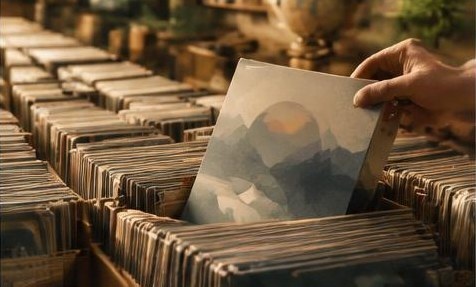
When listening digitally, liner notes can easily disappear behind titles and thumbnails. Yet they can make a recording truly intelligible: through names, the circumstances of its creation and explanations of musical functions. Connecting sound and documentation is not merely an added service for specialists. It opens up other ways of paying attention while also revealing where a release leaves questions unanswered.
Discovery article
Cables as Composition: What Makes Modular Synthesisers Special
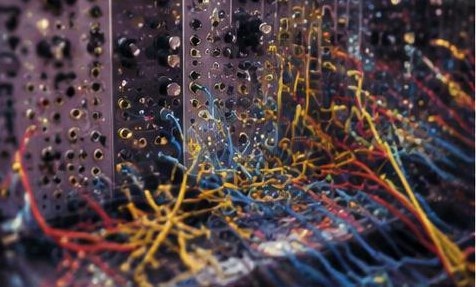
With modular synthesisers, part of the instrument is assembled as you work. Connections between building blocks determine how signals are generated and change. Historical Moog systems and today’s learning environments help explain this principle without technological mythology: what matters is not the number of modules, but the musical idea behind their relationships and their development over time.
Discovery article
From sound to a trail: discovering music without simply following recommendations
Digital music discovery need not end with the next automatically suggested track. Searching for instruments, contributors or different recordings of a work allows you to build your own routes through musical connections. Knowledge of sound and open metadata complement one another here: the former sharpens the question, while the latter helps turn a fleeting listening impression into verifiable research.

Discovery article
Built for a Space: The Organ as a Collective Instrument
An organ is not simply a large musical instrument that happens to stand in a building. Its construction and musical use are closely connected to the particular space. UNESCO therefore describes organ craftsmanship and organ music as a shared practice. It brings together craft, training, performance and long-term responsibility for a sounding cultural heritage.

Discovery article
Reggae beyond the stereotype: a musical culture in motion
Reggae is easily reduced to a few sonic characteristics or familiar images. UNESCO, by contrast, describes music that emerged from different influences and is passed on in a variety of social contexts. A closer approach connects origins and the present without turning this into a rigid test of authenticity. What matters is specific recordings, the people involved and cultural contexts that can be traced.
Discovery article
Small collections, big stories: why regional sound archives matter
Not every culturally significant recording is held in a famous national collection. Regional archives preserve voices, music and sounds whose value becomes apparent only in their local context. The British project Unlocking our Sound Heritage shows how collaboration can safeguard such holdings. Digital portals extend their reach, but do not resolve every question of access and interpretation.

Discovery article
Why a rhythm sounds familiar: shared tendencies and cultural influences
What seems rhythmically self-evident is not the same everywhere. A cross-cultural study involving groups from fifteen countries found both shared tendencies and marked differences. The findings challenge two simple narratives: rhythmic perception is neither entirely arbitrary, nor can a single musical order be declared the natural standard for all humanity.

Discovery article
Hands-on Sound: Making Synthesis Understandable
A synthesiser need not remain a baffling control panel. By exploring the sound source, its development over time and sound shaping separately, you can discover manageable relationships behind its many controls. Interactive learning resources and historical instruments reveal two sides of the same idea: electronic sounds do not simply emerge at the push of a button, but through decisions that can be consciously heard and compared.
Discovery article
Saved does not mean finished: what sound archives need after digitisation
An audio file seems less vulnerable than a fragile physical recording medium. Yet this does not mean a recording is permanently secure. The British Library and the Library of Congress describe risks ranging from material decay to obsolete technology. Digital preservation is therefore not a one-off rescue operation, but an ongoing organisational and technical task.

Discovery article
Lichens: small communities on rough surfaces
On tree bark and stones, lichens often look like inconspicuous patches of colour. In fact, they bring fungi together with photosynthetically active partners to form small living communities. Their sensitivity to environmental conditions makes them interesting to observe. Yet neither every lichen nor every change in its growth can be interpreted through a single, simple explanation.

Discovery article
How bats measure the night
For many bats, darkness is not an obstacle that must be overcome through sharper eyesight alone. They use returning echoes of their own calls to perceive their surroundings. Nevertheless, bats are not blind. Their perception combines several senses, and their varied ways of life do not fit the simple image of a single type of nocturnal insect hunter.

Discovery article
The close-range electrical world of sharks
A prey fish can be hidden yet still leave traces: muscle movements generate weak electric fields. Many sharks detect these signals. Their electrical sense complements smell, hearing and sight, but does not replace them. Understanding this perception therefore means looking more closely at distances, habitats and the diversity of shark species.
Discovery article
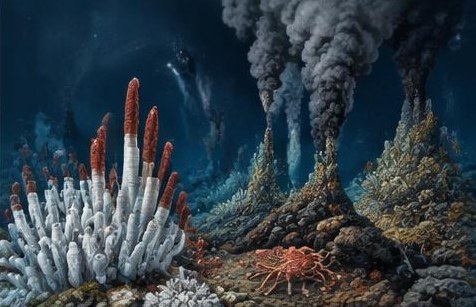
Life at hot vents in the cold ocean
At hydrothermal vents, hot, mineral-rich fluids meet cold seawater. Dense communities of organisms can develop there, with a food base that relies partly on chemical energy rather than directly harnessed solar energy. The animals do not simply live in the hottest water, however. Transition zones, microorganisms and finely balanced relationships with a dynamic environment that is often difficult to access are crucial.

Discovery article
Skin that changes its patterns
Octopuses and other cephalopods can change their appearance remarkably quickly. Pigment cells, reflective structures and, in some species, movable skin projections make this possible. The transformation is neither limitless nor merely decorative. It belongs to a versatile repertoire that allows animals to respond to backgrounds, threats and members of their own species, without requiring human intentions.
Discovery article
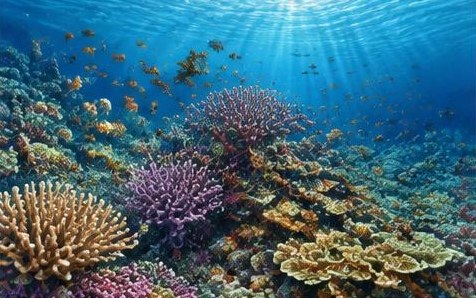
Corals can recover – but not indefinitely
White corals are not necessarily already dead. During bleaching, many reef-building corals lose important photosynthetic partners and come under considerable stress. Recovery is possible, but depends on the duration, severity and recurrence of the stress. Resilience therefore does not mean invulnerability, nor does it provide an all-clear for a reef’s future.

Discovery article
A migration spanning several generations
The migration of North American monarch butterflies is not an annual round trip made by the same animals. Particularly in the eastern population, breeding generations alternate with a longer-lived migratory generation. Anyone seeing a monarch again the following summer is therefore usually not encountering a returning butterfly from the previous year. Behind the familiar image of migrating butterflies lies a complex annual cycle.

Discovery article
Beneath forest trees: fungal partnerships without the internet myth
Mycorrhizal fungi associate with plant roots and influence their supply of water and nutrients. This is often turned into a story about a caring forest network. Research paints a more cautious picture: exchange and connections are important topics, but far-reaching claims about targeted help between trees are not supported by robust data to the same extent.

Discovery article
When pollinators arrive after sunset
Pollination does not end with the last daylight. Moths also transfer pollen and can be important visitors to certain plants. A study of brambles in southern England illustrates their significance particularly clearly. It does not, however, establish a general ranking in which moths are inherently better than bees or other insects active during the day.
Discovery article
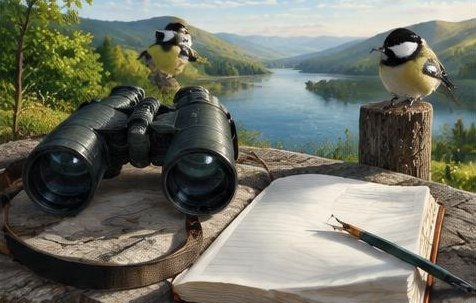
Why an ordinary bird list can be valuable
A rare sighting seems more exciting than repeatedly noting a blackbird. For research, however, regular complete observation lists can be particularly useful. They reveal not only records, but also their relationship to observation effort. Clear information, honest uncertainty and the distinction between not detected and genuinely absent are crucial.
Discovery article
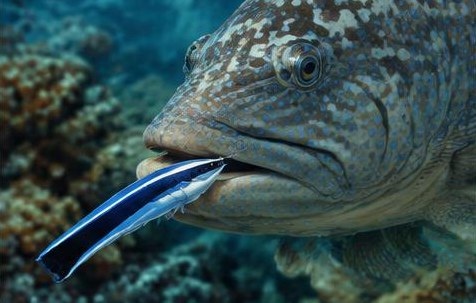
Cleaner fish: cooperation with conditions
On some reefs, large fish allow small cleaners to work on their skin and gills. The cleaners obtain food, while their visitors may lose parasites. This is a vivid example of mutual benefit, but not proof of selfless care. The benefits that arise depend on the species, their behaviour and the particular conditions of the encounter.

Discovery article
A butterfly garden begins with caterpillars
A butterfly on a flower is easy to spot. Yet the conditions that make its life possible often depend on quite different plants. Many caterpillars can feed only on particular foods, while adults visit nectar sources. Anyone wishing to support butterflies must therefore also incorporate signs of feeding, development periods and inconspicuous refuges into their garden design.

Discovery article
Urban foxes: adaptable, but not without problems
Red foxes use parks, gardens and other urban spaces because they can provide food and cover. Their presence is neither a sign of complete disconnection from nature nor straightforward evidence of particularly healthy urban wildlife. These adaptable animals respond to specific opportunities and risks. Their way of life deserves more attention than the cliché of the cunning neighbour.

Discovery article
What urban gardens reveal about biodiversity
Habitats emerge between buildings that seem small yet can support many species. Their value, however, cannot be judged from a single lively afternoon. Urban ecology combines regular observations with different measurement methods. It is important not just to count conspicuous visitors, but also to consider how habitats are used, seasonal patterns and blind spots.

Discovery article
Why the deep sea is not simply dark
Where little sunlight reaches, numerous marine organisms produce their own light or use luminous partners. Bioluminescence can attract prey, confuse predators or alter an organism’s silhouette. The glowing deep sea is therefore no uniform spectacle. Behind similar points of light lie different chemical pathways, ways of life and ecological functions, each of which requires closer investigation.
Discovery article
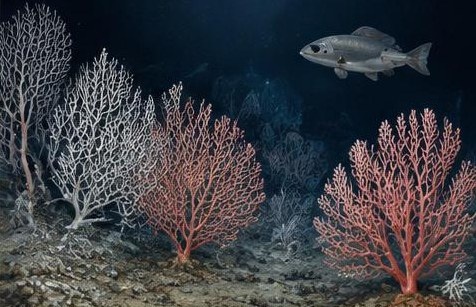
Coral forests beyond sunlight
Corals are not confined to warm, bright, shallow seas. Various species also create spatially complex habitats at great depths. Many feed there on material carried to them, without photosynthetic partners. Their often slow development makes clear why a visible stand can be damaged quickly, while a comparable structure returns only after very long periods.

Discovery article
Deadwood is a habitat in flux
A dead trunk is not simply the end of a tree. As it decomposes, its moisture, structure and nutrient availability change. Fungi, insects and many other organisms make use of different stages in this process. Their diversity therefore depends not only on how much deadwood is present, but also on its form and the periods over which it remains available.

Discovery article
What a mushroom cap reveals about the forest — and what it does not
After damp days, fungal fruiting bodies sometimes appear as if from nowhere. Yet most of the organism often remains hidden. Visible caps therefore tell only part of its story. Looking at fungi as part of forest ecology reveals decomposers, root partners and pathogens, without jumping to conclusions about the condition of the entire forest from a single find.

Discovery article
Wild bees need more than a floral buffet
Flowers provide food for wild bees, but that is not enough to meet all their needs. Many species require suitable soil, while others need hollow stems or existing cavities. Anyone wishing to support pollinators should therefore consider their entire life cycle. Inconspicuous, less tidy features can be just as important as colourful summer planting.

Discovery article
Migratory birds follow more than one compass
Migratory birds find their way using information from an environment that is constantly changing. The sun, stars, landscape and Earth's magnetic field can all play a part. Which cues a bird uses depends on its species, experience and situation. Researchers therefore distinguish between following a direction and the more demanding task of determining one's own location.
Discovery article
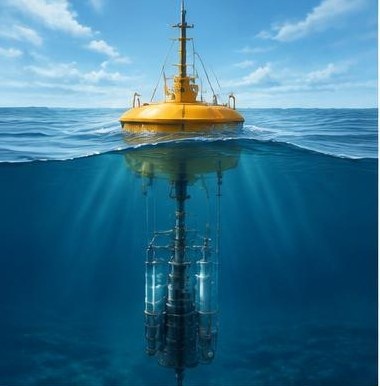
Diving measurement buoys: how Argo observes the ocean from within
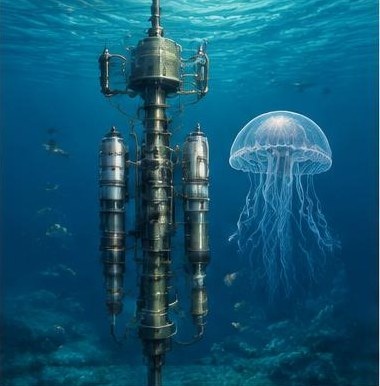
Research vessels can only ever reach a small part of the sea. Argo floats complement them with repeated autonomous dives and vertical measurement profiles. Temperature, conductivity and pressure allow comparisons of the ocean’s internal structure. The principle of global observation is established, but individual profiles remain snapshots whose quality and spatial representativeness must be checked.
Discovery article
More than temperature: how measurement buoys capture biogeochemical processes
Oxygen, nitrate, pH and optical signals broaden the view provided by autonomous ocean buoys. Such measurements can show how biological activity and chemical conditions are linked. They do not, however, simply count every organism. Between a sensor signal and an ecological conclusion lie calibrations, biogeochemical cycles and models whose assumptions must be carefully disclosed and independently checked.

Discovery article
Food from chemical energy: how deep-sea communities function
At hydrothermal vents and cold seeps, chemical energy can sustain local food webs. Microorganisms use suitable reactions to build biomass. This does not make these communities independent of energy or completely separate from the rest of the ocean. What matters are flows of substances, the supply of reactants and, often, close partnerships between microbes and animals.

Discovery article
Many eyes, verifiable data: how citizen science improves quality
Volunteer observations can cover large areas and long periods. Yet their sheer volume is not enough to support scientific conclusions. Projects need transparent protocols, information on observation effort and procedures for checking unusual reports. Birdwatching provides an example of how personal experience of nature and systematic data collection can work together without concealing uncertainty.
Discovery article
FAIR does not simply mean open: what makes research data reusable
Research data can be freely downloadable yet practically unusable. The FAIR principles therefore focus on findability, managed access, interoperability and reuse. They do not inherently require unrestricted downloads. At their heart is a clear, traceable description that helps people and computer systems find and interpret data correctly and reuse them under clear conditions.

Discovery article
Sharper Images through Controlled Light Emission: How Nanoscopy Works
Conventional light microscopy cannot distinguish closely neighbouring structures with unlimited precision. Super-resolution methods circumvent this limit by deliberately controlling the light emitted by labelled molecules. They do not violate any laws of optics. Their images, however, are produced under particular conditions — and initially show the distribution of the labels, not an unfiltered view of the entire cell.

Discovery article
A Ruler for Light: What Optical Frequency Combs Make Measurable
Light oscillates too quickly for ordinary electronics to count its individual waves directly. Optical frequency combs bridge this gap. Their regularly spaced spectrum connects laser light with measurable radio frequencies. The principle helps not only atomic clocks, but also spectroscopy and precise distance measurement — under very different experimental conditions and requirements in each case.

Discovery article
Chemistry in a soft framework: why gels are being studied as catalysts
Catalysts do not act independently of their surroundings. Incorporating active components into a gel changes accessibility, substance transport and mechanical cohesion. This opens up interesting possibilities for electrochemical reactions. A larger surface area or a higher current in the laboratory, however, does not yet prove a superior technology: comparison conditions and long-term behaviour determine how much can be concluded.

Discovery article
Almost all water, yet holding their shape: the material logic of hydrogels
Hydrogels combine large quantities of water with a three-dimensional polymer network. Their properties arise not from water content alone, but from cross-linking, chemical groups and mobile ions. This makes them interesting for soft engineering components and electrochemical systems. The performance actually achievable, however, only becomes clear under appropriate loading and environmental conditions.

Discovery article
The Kilogram without a Prototype: How a Kibble Balance Determines Mass
The kilogram as a unit no longer depends on a single metal object. Its definition is based on a fixed value of the Planck constant. A Kibble balance puts this abstract definition into experimental practice. It links gravitational force with electrical quantities — and shows why an exact definition does not mean a measurement without uncertainty.

Discovery article
Molecules in ice: what cryo-electron microscopy really shows
Cryo-electron microscopy makes the three-dimensional architecture of biological molecules accessible without requiring a crystal for every sample. Extremely rapid cooling traps them in thin, glass-like ice. A three-dimensional reconstruction emerges from many weak individual images. Between the raw image and the structural model, however, lie numerous selection decisions, checks and methodological limitations.

Discovery article
Controlled crossings: how proteins move substances through membranes
Cell membranes separate chemical compartments, but must not be completely impermeable. Membrane proteins allow selected ions, small molecules and even other proteins to cross. Yet their operation cannot be fully understood from structures alone. Only the interplay of spatial models, transport measurements and targeted changes makes plausible mechanisms experimentally robust and comparable.

Discovery article
Open science: why accessibility alone does not guarantee verifiability
A freely accessible scholarly article makes knowledge easier to access. Thorough scrutiny often requires more: data, methods, analytical steps and clear documentation. Open science brings these elements together without automatically making every publication correct. Good openness also takes account of data protection, sensitive information and the work required to keep research materials usable over the long term.

Discovery article
Time from Light: How Optical Atomic Clocks Achieve Their Accuracy
An atomic clock does not count orbiting electrons, but uses the precise resonance of an atomic transition. Optical clocks operate at much higher frequencies than conventional caesium clocks. Their performance, however, does not arise solely from ticking faster: controlling external influences, making suitable comparison measurements and providing a traceable account of all uncertainties are crucial.
Discovery article
What ocean acidification means: a question of chemical equilibria
When seawater absorbs additional carbon dioxide, its chemical equilibrium changes. The pH falls, and carbonate availability can decrease. The word acidification does not mean that the entire ocean is already acidic. Biological consequences also depend on temperature, nutrients, life stage and natural fluctuations at the location concerned.

Discovery article
How light splits water: the chemistry of photosystem II
Photosynthesis is more than a shorthand equation involving light, water and carbon dioxide. In photosystem II, light-driven charge separation is coupled to the stepwise oxidation of water. The oxygen produced comes from the water. Researchers use spectroscopy, structural studies and testable chemical models to work out precisely how the intermediate states involved function.

Discovery article
When plastic comes back together: what self-healing means
A cut in plastic need not always be permanent. Dynamic bonds can reconnect polymer networks under suitable conditions. Self-healing is not a single, uniform material state, but a measurable restoration of particular properties. Whether a material has actually been usefully repaired is shown not by the closed gap alone, but by its renewed ability to withstand loads.

Discovery article
Hearing Temperature: How Sound Makes a Primary Thermometer Possible
A thermometer does not necessarily need a column of liquid or an electrical resistance. The speed of sound in a gas also carries information about its temperature. Acoustic thermometry uses this relationship for particularly fundamental measurements. It connects the motion of molecules with the definition of the kelvin, but requires precise knowledge of gas composition, geometry and deviations from ideal behaviour.

Discovery article
Testing entanglement: what Bell experiments actually rule out
Entangled particles exhibit correlations that cannot be explained by every classical conception of predetermined properties. Bell experiments make this claim quantitatively testable. Their significance lies in statistical measurement patterns, not in a visible connection between individual particles. This opens up new technological possibilities, but permits neither faster-than-light messages nor arbitrary remote control.

Discovery article
Order without an envelope: how cells use molecular condensates
Not every distinct region of a cell has a membrane. Proteins and RNA can organise themselves into concentrated assemblies whose material properties influence biological functions. Such condensates are not, however, invariably liquid droplets. Studying them requires experiments that distinguish composition, exchange and function — and do not hastily apply models to all cellular structures.

Discovery article
ALMA: How radio telescopes see the cold nurseries of stars
Star-forming regions are often dark in visible light because dust blocks the view. The ALMA observatory studies their millimetre and submillimetre radiation. Its linked antennas reveal cold dust and molecular gas. This makes it possible to explore the regions where stars form and where the raw materials for new planets gather around young stars.

Discovery article
Dark energy: what accelerating expansion really means
Observations indicate that the expansion of the universe is not simply slowing down all the time. On large scales, expansion has accelerated in later cosmic epochs. Dark energy is the term for a possible cause within the standard model. Its nature remains an open question and is being investigated using supernovae, galaxy maps and gravitational lensing.

Discovery article
Dark matter: why astronomers infer invisible mass
Dark matter is the name for an as yet unidentified component of matter whose gravitational effects are visible in many places. The movements of galaxies, gravitational lensing and cosmic structures cannot be accounted for by the observed ordinary matter alone. This does not mean that its particles have already been found. Well-measured effects and an unknown nature are two different statements.

Discovery article
Is this exoplanet habitable? What atmospheres really reveal
An Earth-sized planet is not automatically a second Earth. Its atmosphere, radiation environment and evolutionary history also matter when assessing potentially life-friendly conditions. Telescopes can study selected gases or a planet’s thermal radiation. Such measurements are valuable, but neither a single molecule nor a location in the habitable zone proves habitability or life.

Discovery article
How do we discover exoplanets lost in starlight?
Most exoplanets are not photographed as clearly recognisable worlds. Instead, astronomers measure their effect on their host star: regular dimming, tiny changes in velocity or shifts in position. Each method favours particular types of planet. Only by combining them can a conspicuous signal become a reliable description of size, mass and orbit.

Discovery article
Gravitational lenses: when galaxies bend the light of other galaxies
Large masses alter the paths along which light travels through spacetime. If a galaxy or galaxy cluster lies in front of a distant source, distorted arcs, multiple images or amplified signals can arise. Gravitational lenses are therefore both natural observational aids and tools for measuring matter that emits little or no light of its own.

Discovery article
Gravitational waves: how to measure tiny changes in spacetime
Gravitational waves are changes in spacetime that propagate outwards. Particularly strong measurable signals arise when compact objects such as black holes or neutron stars orbit one another and merge. Detectors do not measure ordinary sound waves. They compare light paths with extreme precision, providing access to events that may remain invisible in light.
Discovery article
James Webb: Why an infrared telescope tells different stories
The James Webb Space Telescope observes mainly infrared light. It uses this to study distant galaxies, dust-shrouded star formation and the atmospheres of selected exoplanets. Its large mirror is only part of its success. Low instrument temperatures, suitable spectrographs and an observing position from which interfering heat can be effectively screened out are just as important.

Discovery article
Light years, parallaxes, standard candles: how cosmic distances are measured
A light year is a distance, not a measure of time: it corresponds to approximately 9.46 trillion kilometres. But how do we determine distances that no tape measure can span? Astronomers combine geometric measurements with known relationships involving luminosity. This distance scale stretches from nearby stars to distant galaxies, with its own uncertainties at every stage.
Discovery article
Cosmic background radiation: the oldest light we can see
The cosmic microwave background radiation comes from an epoch when the universe first became largely transparent. Today, its spectrum corresponds to approximately 2.725 kelvin. Tiny differences across the sky contain information about the early density fluctuations. They do not show the Big Bang itself, but an early state of the cosmos, long before the first stars shone.

Discovery article
Pulsars: why dead stars flash like cosmic lighthouses
Pulsars are rotating neutron stars whose beams of radiation regularly sweep across our line of sight. Their apparent flashing does not mean that the entire star is constantly switching on and off. Particularly stable pulsars serve as precise timekeepers. Their signals help researchers investigate compact matter, galactic movements and even very slow changes in spacetime.

Discovery article
How does a rocket work in the vacuum of space?
A rocket does not need to push against air. It accelerates by expelling mass it carries backwards, thereby gaining momentum in the opposite direction. This principle also works in a vacuum. During a launch into orbit, building up a very high sideways velocity is usually harder than simply gaining altitude.

Discovery article
Sagittarius A*: how stellar orbits measure the centre of the Milky Way
At the centre of the Milky Way lies Sagittarius A*, a supermassive black hole with approximately four million solar masses. The principal means of determining its mass came not from a look inside, but from the motion of nearby stars. Their orbits also make the galactic centre an exceptional testing ground for gravity.

Discovery article
Black holes: what the event horizon is — and what it is not
A black hole is not an ordinary sphere with a solid surface. Its event horizon bounds a region from which signals can no longer escape. Yet its surroundings can still be studied. Orbiting stars, hot gas and gravitational waves provide different information about mass, motion and extreme spacetime.

Discovery article
Weightlessness: why space stations fall without crashing
Astronauts do not float because there is no gravity in Earth orbit. Together with their space station, they are in free fall. Their high sideways velocity ensures that they continually miss Earth. This principle also explains why temporary weightlessness is possible in drop towers and research rockets.

Discovery article
Temperatures in space: why space is not simply cold
There is no single temperature in space. The cosmic background radiation corresponds to about 2.7 kelvin, while sunlit components can become hot and shielded surfaces very cold. Anyone asking about the temperature of space therefore needs to distinguish between radiation, tenuous gas and a specific object in a vacuum.

Discovery article
Space debris: why small fragments cause big problems
Space debris consists of defunct satellites, rocket remnants and fragments. The danger lies not only in their quantity, but above all in their high speed. Even small pieces can damage active spacecraft. The so-called Kessler effect describes the possibility that collisions generate further debris, making individual orbital regions increasingly difficult to use over the long term.

Discovery article
How big is space? What we can measure – and what we cannot
The observable universe has a diameter of approximately 93 billion light-years. That does not mean that space as a whole is the same size. The crucial distinction is between an observational limit and an actual edge. Cosmic expansion explains why we can see further than the age of the universe might initially suggest.

Discovery article
How dust becomes planets: The difficult steps in between
Planets grow in the discs of gas and dust surrounding young stars. Tiny grains must first develop into larger bodies before gravity can substantially accelerate their growth. The transitions between these size ranges are particularly challenging. Observed rings, theoretical models and the diversity of known planetary systems provide different clues.

Discovery article
How do stars form? From cold gas to a glowing fusion reactor
Stars form when parts of cold gas clouds become denser under their own gravity. But collapse alone does not explain the entire process. Turbulence, magnetic fields, rotation and radiation from young stars influence how much material gathers together. Only when temperatures inside are sufficiently high does hydrogen fusion begin to provide a sustained source of energy.

Discovery article
The Albula Railway: In Bergün, the view gains a backstory
A journey through the mountains of Graubünden feels different when you understand the engineering that makes it possible. The Albula Railway Museum in Bergün connects historic plans and everyday objects with the UNESCO World Heritage railway line. Rather than covering as many miles as possible, it is worth taking a trip with a break: first observe, then understand, and afterwards look again more closely.

Discovery article
Bavarian Forest: getting closer to the lynx without pursuing it
A lynx cannot be ordered up like a tourist attraction. In the Bavarian Forest, this very uncertainty offers a valuable approach to observing nature. Educational activities and outdoor animal enclosures help visitors learn about this elusive cat and the research into it. A clear distinction between an animal in an enclosure and a chance encounter in the wild remains essential.
Discovery article
Berlin: Discovering Natural History Along Your Own Route
Berlin's Museum für Naturkunde is not just a home for large skeletons, but a place of scientific collections and open questions. For an accessible cultural visit, a personal route is more worthwhile than a complete circuit. The museum explicitly identifies existing barriers; this transparency helps visitors prepare realistically and according to their own needs.

Discovery article
Discovering the Bernina: A railway journey is more than a panoramic photograph
The Rhaetian Railway’s UNESCO World Heritage line combines engineering history with impressive landscapes between Thusis and Tirano. A less tightly scheduled approach is particularly worthwhile on a well-known route. Those who prepare what they want to observe, allow for breaks and do not organise everything around a particular train service experience the journey more attentively and with less pressure from expectations along the way.

Discovery article
Orth an der Donau: Floodplain life between observation points and river dynamics
In the Donau-Auen, water is not merely a backdrop but a shaping force. Around Orth, this can be combined with wildlife watching. The Schlossinsel offers an interpreted introduction, while the surrounding area reveals broader ecological connections. It is important to distinguish between animals in enclosures and free-living species, and to check current path closures.
Discovery article
Dresden: Examining Your View of Humanity at the Hygiene Museum
The Deutsches Hygiene-Museum sees itself as a museum of the human being. Its permanent exhibition combines knowledge of the body with questions about perception, science and self-image. The institution is particularly interesting for accessible cultural travel because it describes physical measures and different forms of interpretation in specific terms. A good visit begins with choosing the approach to the subject that suits you personally.

Discovery article
Stars over the Eifel: Look up outdoors, respect protected spaces
The Eifel National Park protects not only forests and animals, but also the natural night. For travellers, this means an important distinction: the dark sky is an invitation to observe, but the national park itself is not a night-time adventure playground. Officially recommended sites nearby combine astronomy with consideration for habitats sensitive to disturbance.

Discovery article
Frankfurt: Leaving familiar ways of finding your bearings behind at the Dialogmuseum
At Frankfurt’s Dialogmuseum, blind or partially sighted experts guide visitors through a lightless course. The visit changes familiar roles and directs attention towards hearing, touch and communication. As a cultural travel destination, the museum is particularly rewarding when the experience is not mistaken for a complete picture of blind people’s everyday lives.
Discovery article
Garching: A journey into space that does not wait for clear weather
Astronomy trips need not depend on cloudless nights. The ESO Supernova in Garching combines an interactive exhibition with a planetarium, bringing research to life. Visitors who consciously distinguish between the two formats gain a useful foundation for later skywatching. A visit is particularly well suited to preparing questions rather than simply consuming spectacular images of the universe.

Discovery article
Ries Geopark: A Cosmic Event in an Everyday Landscape
In the Nördlinger Ries, an enormous impact crater lies not behind a barrier, but beneath towns, fields and transport routes. It is precisely this inhabited normality that makes the region fascinating. Viewpoints and geological interpretation help visitors understand how an event around 15 million years ago continues to leave a clearly recognisable mark on the landscape.

Discovery article
Messel Pit: Seeing Fossils and Understanding Their Limits
Messel Pit has preserved not only bones, but, in some fossils, hair, feathers or stomach contents too. This exceptional preservation makes the site a window onto a world around 47 million years old. A visit combines wonder with an important question: what can actually be inferred from such finds?

Discovery article
Hainich: forest perspectives with precise accessibility planning
The treetop walkway in Hainich reveals a habitat that is otherwise difficult to reach. A lift makes access easier, but not every part of the site is equally accessible. For a successful trip, it is therefore worth looking at specific routes, individual needs and weather conditions rather than relying on a blanket promise of a fully accessible nature experience.

Discovery article
Potsdam: The Einstein Tower is more than an architectural subject
On Potsdam’s Telegrafenberg, the Einstein Tower combines striking architecture with solar research. Precisely because the building remains in scientific use, visiting conditions differ from those of an ordinary museum. By combining an exterior view, a digital exhibition and, where possible, a pre-booked guided tour, visitors discover a research site whose function is easily overlooked behind its famous form.

Discovery article
Rhön: A stargazing trip begins with less light
The Rhön combines open landscapes with an unusually dark night sky. Anyone wishing to observe the stars here needs a suitable location, patience and consideration before they need a large telescope. A trip to the dark sky park also shows why natural darkness is a part of the landscape worth protecting, rather than a leisure resource available without limits.

Discovery article
Swiss National Park: Good wildlife watching needs clear boundaries
In the Swiss National Park, visitors’ wishes do not dictate the daily routine. Marked paths, designated rest areas and seasonal protection rules set the framework. Within these limits, marmots, chamois or red deer can be observed with patience. Those who rely on optics and time rather than approaching animals experience the Alpine landscape more closely and disturb its inhabitants less.

Discovery article
Semmering: walking the railway between engineering and landscape
At Semmering, a historic mountain railway can be experienced from two perspectives: from the train and from public walking trails. The appeal lies in alternating between the two. By choosing short stages, checking current trail conditions and allowing enough time for the return journey, visitors discover engineering as part of an inhabited landscape rather than as an isolated attraction.

Discovery article
Vulkaneifel: why not every maar is a blue lake
The Vulkaneifel's well-known lakes tell only part of the story. Some maars have silted up; others survive as dry depressions. Travelling with this knowledge reveals a more varied volcanic landscape and prevents visitors from assuming that every round expanse of water was formed by the same process. A geopark visit is particularly rewarding when observation and expert explanation come together.

Discovery article
Wadden Sea: watching seals without driving them into the water
A resting seal is not an animal waiting to be entertained. Sandbanks in the Wadden Sea are important refuges for rest, raising young and moulting. Anyone hoping to see harbour seals or grey seals should therefore start with distance, tides and conservation rules. Good observation means that the animals change their behaviour as little as possible.

Discovery article
Westhavelland: Plenty of sky, no need to hurry
In Westhavelland, darkness itself becomes a travel destination. The expansive landscape offers good conditions for a first encounter with the Milky Way, but the moon’s position and summer twilight alter the experience considerably. Those who use official observation sites and stay for a few nights discover more than a single astronomical subject on the horizon.

Discovery article
Winterthur: At Technorama, Repetition Is Positively Worthwhile
Technorama in Winterthur is a destination for people who want more than explanations of science. Experimental stations make movement, light, sound and perception directly tangible. The best approach is surprisingly slow: choose a few experiments, change the conditions and repeat the same observation, rather than operating as many stations as possible in succession.

Knowledge & Space
The Growing Universe: Size, Age, and Expansion
The universe is about 13.8 billion years old—and the region observable today is roughly 93 billion light-years across. This apparent contradiction takes us straight into modern cosmology: light travels through space that changes along the way.

Knowledge & Space
Galaxies, Stars, and Planets: A Universe Without a Complete Inventory
Hundreds of billions of galaxies and unimaginably many stars: the scales are fascinating, but no complete cosmic inventory exists. The crucial distinction is between what is counted, what is extrapolated, and what is merely assumed.

Knowledge & Space
Cosmic Giants: Large Planets and Stars Compared with Earth
A planet roughly 21 Earth diameters across and a star with a radius of approximately 2,000 solar radii: cosmic size records exceed our everyday experience. But “larger” can refer to radius, volume, or mass—and rankings are by no means definitive.

Knowledge & Space
A Light-Year: A Distance That Challenges Our Imagination
A light-year is not a span of time, but approximately 9.46 trillion kilometers. The unit connects distances with the travel time of light—and explains why looking at the stars always also means looking into the past.

Knowledge & Space
Life in the Universe: Many Possibilities, No Credible Overall Percentage
Planets are common. We do not yet know whether life also arises frequently. An interesting exoplanet, a possible biosignature, and a technological civilization involve different questions—and very different uncertainties.

Knowledge & Space
Beyond Our Horizon: Does the Universe End Somewhere?
The limit of what we can observe is not automatically the boundary of the universe. The question of an “outside” encompasses several different ideas: more space, a finite universe without an edge, or a hypothetical multiverse.

Knowledge & Space
Astrology and Astronomy: Shared Roots, Different Standards
People have observed and interpreted the sky for thousands of years. Astronomy and astrology share part of their history, but today their methods differ fundamentally: personal meaning is not the same as a testable prediction.

Knowledge & Space
Living on the Moon and Mars: From Visits to an Independent Settlement
Technology can enable humans to survive in hostile environments. But a short mission, a permanently inhabited outpost, and a self-sufficient city are three entirely different goals. The Moon and Mars illustrate how much separates a vision from dependable everyday life.

Knowledge & Space
A Journey Through Cosmic Time: The Universe, Sun, Earth, Moon, and Humanity
13.8 billion years of cosmic history, 4.6 billion years for the Sun, and around 300,000 years for Homo sapiens: only by comparing these timescales can we see how young our own species is relative to its surroundings.

Knowledge & Space
The Invisible Universe: Dark Matter and Dark Energy
Stars and planets make up only a small part of the cosmic matter–energy budget. Dark matter and dark energy describe different unresolved problems—and “dark” here means above all that their fundamental nature remains unknown.

Knowledge & Space
Black Holes: Extreme Gravity, Not Cosmic Vacuum Cleaners
A black hole is not a hole in solid ground or a vacuum cleaner that sweeps up the entire universe. It is a region of spacetime with a special boundary: no light can escape outward from inside the event horizon.
Discover